


If you’ve ever watched a plane lift off and wondered, “Who makes sure that thing is actually safe?”, this guide is for you.
The answer, in Canada, is an Aircraft Maintenance Engineer, usually shortened to AME. They’re the people who inspect, repair and sign off on aircraft so that it’s legal and safe to fly. And here’s the good news: you don’t need to know anything about aviation to start. I’ll explain how it all works from scratch, in plain language, like we’re chatting over coffee.
By the end of this post you’ll know what an AME does, which licence you need, how long it takes, what it costs, what the exams look like, how much you can earn, and the answers to the questions everyone asks.
A quick note on 2027: The requirements below are based on Transport Canada’s published rules, which I checked while writing this. Aviation rules don’t usually change overnight, but they do get updated. Before you spend any money, always confirm the details oIf you’ve ever watched a plane lift off and wondered, “Who makes sure that thing is actually safe?”, this guide is for you.n the Transport Canada website and with your chosen college.
Quick answer: how do you become an AME in Canada?
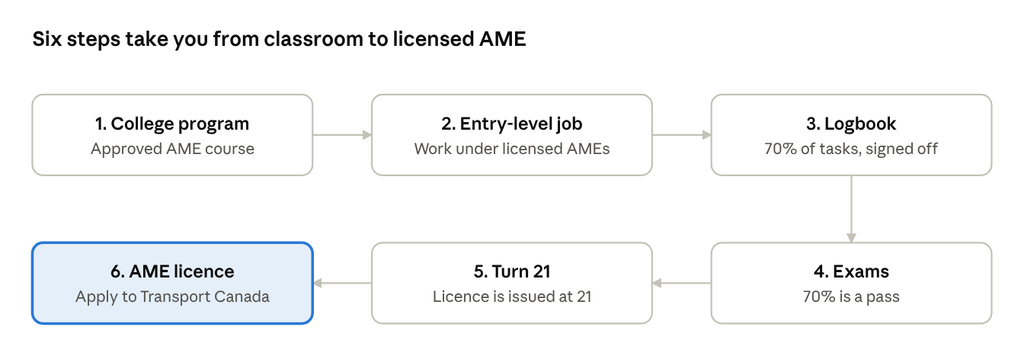
The short version looks like this:
- Complete an approved AME training program (usually at a college, about 2 years).
- Work under licensed AMEs to build hands-on experience (48 months total for most licences, but your college program counts for a big chunk).
- Pass the Transport Canada exams (70% is a pass).
- Build a logbook proving you can do the real tasks.
- Be at least 21 years old.
- Apply to Transport Canada for your AME licence.
That’s the whole road. Now let’s walk it properly.
First, what is an “aircraft engineer” in Canada?
This trips up almost everyone, so let’s clear it up.
In many countries, people say “aircraft engineer” to mean the person who fixes planes. In Canada, that person is an Aircraft Maintenance Engineer (AME), also called an aircraft technician or aircraft mechanic in everyday talk. Despite the word “engineer”, you do not need a university engineering degree.
There is a different career called aerospace engineer. Those people design aircraft, usually with a university degree in engineering. AMEs maintain and repair aircraft, usually with a college diploma and a Transport Canada licence.
| Aircraft Maintenance Engineer (AME) | Aerospace Engineer | |
| Main job | Inspect, repair, certify aircraft | Design and test aircraft and systems |
| Education | College program (about 2 years) | University degree (4+ years) |
| Licence | Transport Canada AME licence | Often a professional engineer (P.Eng.) licence |
| Works with | Tools, aircraft, hangars, airports | Computers, models, labs, factories |
This post is about the first one.
What does an AME actually do all day?
Think of an AME as a mix of mechanic, detective and safety inspector. Day to day you might:
- Inspect engines, wings, landing gear and cabin systems on a schedule.
- Find out why a warning light came on (this is called troubleshooting).
- Replace worn parts and repair damage.
- Test systems before the aircraft returns to service.
- Fill out detailed paperwork. Yes, lots of paperwork. In aviation, if it isn’t written down, it didn’t happen.
- Sign a maintenance release, which is basically your professional promise that the work was done correctly and the aircraft is safe.
That signature is the most important part of the job, and it’s why the licence exists. Only a licensed AME can sign that release.
Aviation 101: how the system works
Before we go deeper, here’s the tiny bit of background that makes everything else make sense.
- Transport Canada is the government body that makes the rules for aviation safety and issues AME licences.
- The Canadian Aviation Regulations (CARs) are the rulebook. You’ll study these for your exam.
- An aircraft is made of systems: the airframe (body), powerplant (engines), propellers, electrical and avionics (the electronics), hydraulics and more.
- An AMO (Approved Maintenance Organization) is a company approved by Transport Canada to maintain aircraft. Many entry-level jobs are at AMOs.
- A logbook is your personal record of the work you’ve done and who supervised it.
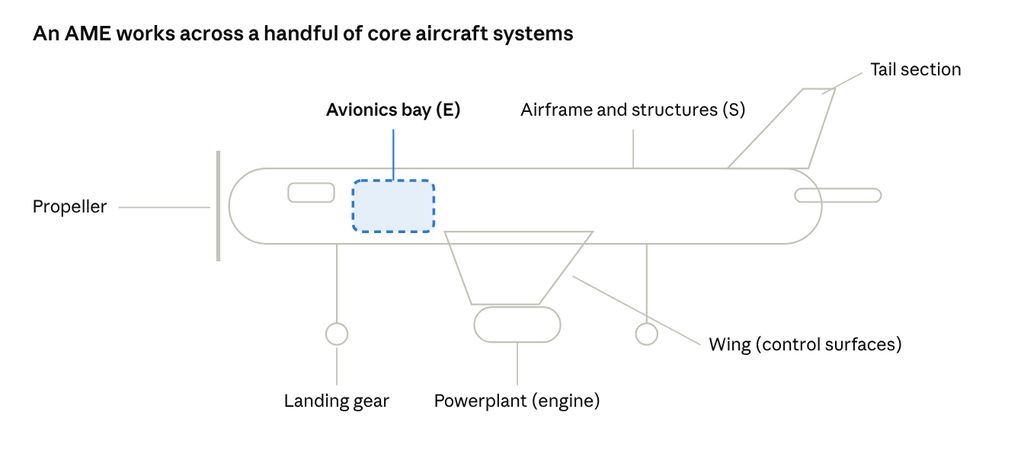
Diagram of the main aircraft systems an AME inspects and repairs
The AME licence types explained (M1, M2, E, S)
Canada doesn’t give one single “aircraft mechanic” licence. It gives ratings, and each one covers different work. According to Transport Canada, the main ones are:
- M1: Non-turbojet aircraft built to certain standards (think smaller piston and turboprop aircraft). It covers the airframe, engines, propellers, components, structures and systems.
- M2: All aircraft not in M1 (excluding balloons). This is the big-aircraft licence, including jets.
- E (Avionics): Aircraft electronic systems such as communications, navigation, autopilot, instruments and the electrical parts of other systems.
- S (Structures): Aircraft structures, meaning all airframe structures. Think metal repair, composites and structural damage.
- Balloons: A separate rating for hot-air balloons.
Two useful details:
- M1 and M2 holders can also sign for turbine-powered helicopters and certain older SFAR 41C aeroplanes.
- If you hold both M1 and M2, you also get the privileges of E and S.
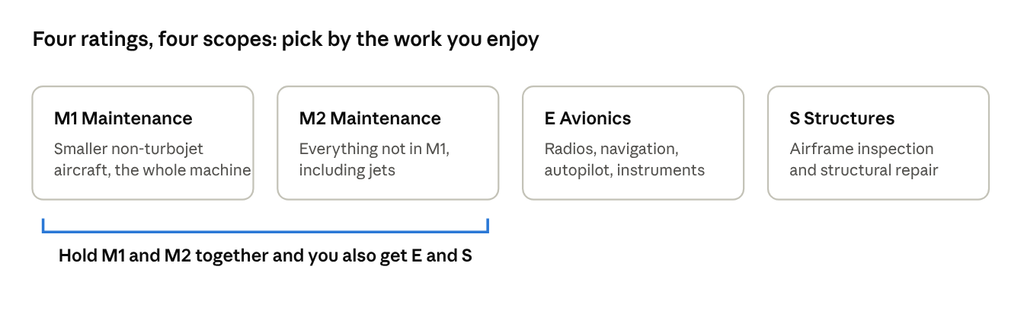
AME licence categories in Canada explained: M1, M2, E and S
Which one should you pick?
- Love engines, hydraulics and general mechanical work? Go M. It’s the most common and most flexible choice.
- Love electronics, wiring and computers? Go E (Avionics).
- Love metalwork, composites and repairs? Go S (Structures).
- Not sure? Start with M. Most people do, and it opens the most doors.
The requirements, simply put
Transport Canada lists six things you need to show for an AME licence. Here they are in plain English:
- Citizenship: You need proof of citizenship of any country. You do not have to be Canadian to hold the licence (more on this in the FAQ).
- Age: You must be at least 21 for the licence to be issued.
- Training: A basic training program in the right subject.
- Knowledge: Passing exams (or getting exam credit through an approved college).
- Experience: Real, hands-on work on aircraft.
- Skill: Proof you’ve done a representative range of maintenance tasks.
Here’s the heart of it, based on Transport Canada’s table:
| Rating | Minimum basic training | Total experience | Specialty experience | Civil experience |
| M1 | 1,000 hours of aircraft maintenance theory | 48 months | 12 months | 6 months |
| M2 | 1,000 hours of aircraft maintenance theory | 48 months | 12 months | 6 months |
| E | 1,000 hours of electronics theory | 48 months | 12 months | 6 months |
| S | 550 hours of aircraft structures theory | 36 months | 24 months | 6 months |
| Balloons | Acceptable balloon maintenance course | 120 hours | n/a | n/a |
Don’t let “48 months” scare you. That’s four years of experience, but a good college program can credit about 18 months toward it (about 10 months for the S rating). That’s why most people finish the journey in roughly four years from the day they start school, not eight.
What do “specialty” and “civil” experience mean?
- Specialty experience: Work in the specific area of your licence. For M, that’s on-aircraft maintenance across the whole aircraft.
- Civil experience: Work on civil (non-military) aircraft. Even if you start in the military, you need at least six months on civil-registered aircraft.
Step-by-step: your path from zero to licensed AME
Step 1: Finish high school (or equivalent)
Most AME programs want high school with decent marks in math, physics or science, and English. Check each college’s exact entrance requirements.
Step 2: Choose and complete an approved AME program
This is the single most important decision. Pick a college whose program is approved by Transport Canada (an “Approved Training Organization”). Why? Because approved programs include the technical exams as part of the course and give you experience credit. Skip that and you’ll face a longer, harder road.
Transport Canada maintains an official list of approved and acceptable basic training courses. Schools that have offered AME programs include BCIT (British Columbia), SIIT (Saskatchewan) and Red River College Polytechnic’s Stevenson Campus (Manitoba), along with many others across Canada. Always confirm the current approval status on the Transport Canada list before applying.
Typical program facts to compare:
- Length (often around two years, depending on the school and rating)
- Tuition and tool costs
- Whether it includes M, E or S training
- How much experience credit it gives
- Whether graduates get hired quickly in your region
[Image suggestion: stock photo of students working on a training aircraft engine in a college hangar. Alt text: “AME students learning on an aircraft engine at a Canadian college.”]
Step 3: Get your first aviation maintenance job
After school you usually start as an apprentice or junior technician, working under a licensed AME. You’ll do real tasks, and your supervisor signs off the work in your logbook.
Typical employers include:
- Regional and major airlines
- Charter and bush operators
- Helicopter companies
- Maintenance, repair and overhaul (MRO) shops
- Aircraft manufacturers
- Flight schools
- Military and government fleets
An important rule: experience on ultralight, advanced ultralight, amateur-built or owner-maintained aircraft does not count toward your licence.
Step 4: Build your logbook (this is your proof)
This step is where many people get sloppy, so pay attention.
Transport Canada wants proof that you’ve done a representative selection of maintenance tasks. Specifically, you must show you’ve completed at least 70% of the applicable tasks listed in the official task list (Appendix B of Airworthiness Manual Chapter 566). Each task must have been supervised and certified by a licensed AME or an equivalent person, with the date, aircraft type and registration (or component serial number).
Your supervisor is confirming that you can:
- Identify the correct standard for the task
- Choose the right tools
- Do the work correctly without supervision
- Complete the paperwork
Also, at least 10% of your required tasks need to be on civil-registered aircraft.
My practical tip: keep your logbook updated weekly, not “when I remember.” Get signatures the same week. Chasing a supervisor who has moved to another company two years later is a nightmare.
Step 5: Pass the Transport Canada exams
You’ll write:
- Technical exams for your rating (for M: Airframe and Powerplant; for E: Avionics; for S: Structures), plus Standard Practices.
- The Regulations (REGS) exam, which tests your knowledge of the Canadian Aviation Regulations.
Key exam facts from Transport Canada:
- The passing grade is 70%.
- If you fail your first attempt, you must wait 30 days. After a second or later failure, the wait is six months.
- Approval to attempt the exams is valid for 12 months.
- Exams happen in person at a Transport Canada Regional Service Centre, by appointment.
- If you graduated from an approved program, you often get credit for the technical exams, but you still do the regulations exam.
- The REGS exam can be attempted once your application is approved and you’re within six months of finishing your required experience.
Transport Canada also publishes a free study guide, TP 14038, with sample topics and resources.
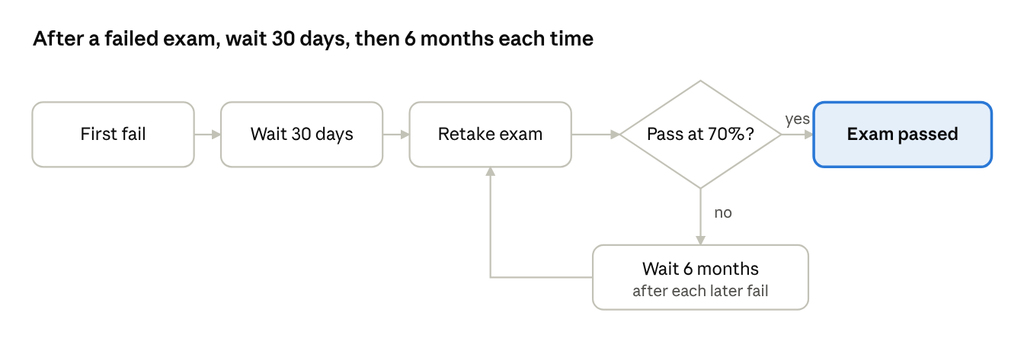
AME exam retake rules in Canada
Step 6: Turn 21 and apply for your licence
You can study and work before 21, but the licence itself is only issued at 21.
There are two application forms depending on your route:
- Form 26-0638: For people who need to prove technical knowledge by writing Transport Canada’s technical exams.
- Form 24-0083: For people who completed an approved training program with knowledge credit, or who already passed the technical exams. You should have all but six months of the total experience at the time you apply.
Submit your documents (originals or certified copies) to your nearest Transport Canada Centre. Fees apply and are listed in the Canadian Aviation Regulations, so check the current amount before you apply.
Step 7: Keep your licence valid
An AME licence has an expiry date, and you must renew it before then. You also need to stay current by doing maintenance or related work. If a licence stays expired for a long time, extra requirements apply, such as rewriting the regulations exam. Check Transport Canada’s renewal page for the exact current rules.
How long does it take, in real life?
Here’s a realistic timeline:
| Stage | Typical time |
| College program | About 2 years |
| On-the-job experience after school | Roughly 2.5 years (to reach 48 months, minus about 18 months college credit) |
| Exams, paperwork and processing | Overlaps, but plan a few months |
| Total | About 4 to 5 years from day one |
People who start the military route or an apprenticeship can follow different timelines.
How much does it cost?
I won’t pretend there’s one number, because college tuition, tools, housing and exam fees vary a lot by province and school. Plan for:
- Tuition and fees (varies by school and whether you’re domestic or international)
- Tools (some programs require a starter toolkit)
- Books and supplies
- Transport Canada exam and licence fees
- Living costs while studying
Ask each college for a full cost breakdown. Look into student grants, loans, scholarships and employer-sponsored training, because the aviation industry often supports new technicians.
How much do AMEs earn in Canada?
Wages depend on your experience, rating, employer and region. As a reference point, Canadian labour force survey data (2025) for the occupation group “aircraft mechanics and aircraft inspectors” shows roughly:
- Low: about $24.48 per hour
- Median: about $39.00 per hour
- High: about $52.88 per hour
Apprentices start near the low end. Licensed, experienced AMEs, leads and inspectors climb toward the high end, and remote, northern or specialized work can pay extra. Many employers also offer benefits such as pensions and health coverage.
What about the job market? Government Job Bank outlooks for aircraft mechanics and inspectors in many regions are rated as good for 2025 to 2027, driven by retirements, fleet growth and defence spending. Conditions differ by region, so check Job Bank for your area.
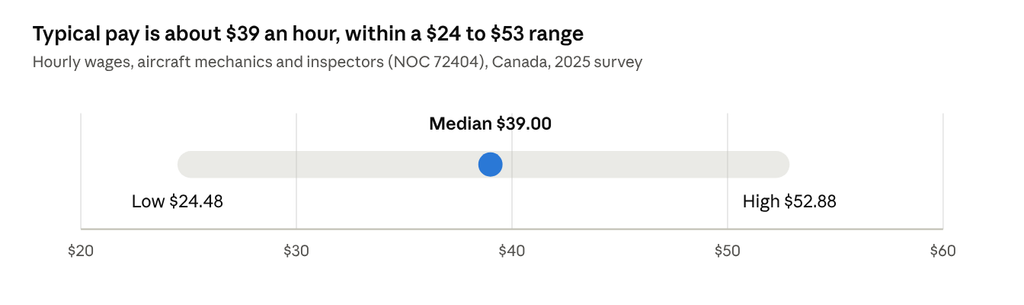
Aircraft mechanic hourly wage range in Canada · Job Bank / Labour Force Survey 2025
Other routes into the career
The military route
The Canadian Armed Forces train aviation technicians (Aviation Maintenance Technician, Avionics Systems Technician and Aircraft Structures Technician). Transport Canada has assessed those trades against its training requirements. Some need little or no extra theory, and others have gaps you must fill. Military maintenance can count toward your experience, but you still need at least six months on civil aircraft and 10% of your tasks on civil-registered aircraft.
Apprenticeship
Some provinces run formal AME apprenticeship programs. For example, Newfoundland and Labrador’s program requires 7,200 hours of approved work experience for M1, M2 and E, and 5,400 hours for S, alongside a Transport Canada licence. Rules vary by province, so check your provincial apprenticeship authority.
Foreign-trained technicians
If you already hold a maintenance licence from another country, you may qualify for an exemption from the basic training requirement if your licence meets ICAO standards and Transport Canada accepts it. You’ll need documentation, including a letter from your civil aviation authority, and you’ll still write the Canadian regulations exam.
Frequently asked questions
Do I need a university degree to become an AME in Canada?
No. A college diploma from an approved AME program is the usual route. A degree is only needed if you want to become an aerospace engineer who designs aircraft.
Can I be an AME if I’m not a Canadian citizen?
Transport Canada accepts proof of citizenship from any country. However, being allowed to hold the licence is not the same as being allowed to work. You’ll still need legal permission to work in Canada, such as permanent residence or a valid work permit.
How old do I have to be?
You can start training whenever your school accepts you, but the licence is issued at 21.
Can I work on aircraft before I’m licensed?
Yes, as an apprentice or trainee, but only under supervision. You can’t sign the maintenance release until you’re licensed.
Is it hard to pass the exams?
They’re challenging but fair, and the pass mark is 70%. Graduates of approved programs usually write only the regulations exam, because the technical exams are built into the course.
What if I fail an exam?
You can retake it. Wait 30 days after a first failure and six months after later failures.
M1 or M2: what’s the difference?
M1 covers smaller non-turbojet aircraft. M2 covers everything else except balloons, including jets. Many AMEs start with one and add the other later by getting more experience on those aircraft types.
Can I add more ratings later?
Yes. For example, to add M2 you generally need extra experience on M2-category aircraft, in addition to meeting the other requirements. Transport Canada explains the details.
What’s the difference between an AME and an avionics technician?
An AME with an E rating is the avionics specialist. An M-rated AME focuses on mechanical systems, engines and the whole aircraft.
What’s “type training”?
On certain aircraft, such as transport category aeroplanes and turbine helicopters, you need approved training for that specific aircraft type before you can sign a release. Employers usually arrange and pay for it.
Is aircraft maintenance a stressful job?
It’s responsible work. You’re accountable for safety, and schedules can be tight, with shifts at night, weekends and holidays. Many people love the pride and the problem-solving. Others prefer less pressure. Job shadowing at an airport or hangar is the best way to find out.
Is it physically demanding?
Often, yes. You may work in tight spaces, lift parts, stand for long periods, and work outdoors in cold or hot conditions.
Will AI or automation take these jobs?
Tools like drones for inspections and 3D printing for spare parts are changing parts of the job, but someone still has to certify the work. Human judgment and a licensed signature are required by law.
Where can I work after getting licensed?
Airlines, charter companies, helicopter operators, MROs, manufacturers, the military, government fleets and more. Your licence also travels: many AMEs work in remote regions or abroad after converting their qualifications.
Is the licence valid forever?
No. It has an expiry date and must be renewed, and you need to stay current in the work.
Common mistakes to avoid
- Choosing a school that isn’t Transport Canada-approved. You may lose credits and face a longer path.
- Ignoring your logbook. Poor records can delay your licence.
- Counting the wrong experience. Ultralight and owner-maintained aircraft don’t count.
- Leaving the regulations exam to the last minute. Start studying early.
- Not asking supervisors to sign promptly. Do it every week.
Your next steps
- Visit a local airport or hangar and talk to working AMEs.
- Check Transport Canada’s list of approved AME training courses.
- Compare two or three colleges on cost, length and job placement.
- Check entrance requirements and application deadlines.
- Decide on M, E or S.
- Start a simple notes file on aviation vocabulary now. It makes school much easier.
Final thoughts
Becoming an AME takes patience, usually four to five years from the first day of class to a licence in your hand. But it’s a hands-on career with real responsibility, solid pay, and a view of the world most people never see: the inside of an aircraft.
If you like solving problems, working with your hands and being trusted with something important, this might be the career for you.
Have a question I didn’t answer? Leave a comment and I’ll add it to this guide.
Sources and further reading
- Transport Canada: Canadian AME Licensing General Information (tc.canada.ca)
- Transport Canada: Obtaining an Aircraft Maintenance Engineer (AME) Licence
- Transport Canada: Airworthiness Manual Chapter 566 and Appendix B (task list)
- Transport Canada: TP 14038 Study and Reference Guide for AME Examinations
- Government of Canada Job Bank: Aircraft mechanics and aircraft inspectors (NOC 72404) outlook and wages
- Government of Newfoundland and Labrador: General Conditions for the Aircraft Maintenance Engineer Trade
- BCIT, SIIT and Red River College Polytechnic Stevenson Campus program pages
Disclaimer: This article is general information, not official advice. Requirements, fees and approved programs can change, so always confirm with Transport Canada and your chosen college.

